Rosario Secretly Takes and Buries Her Dead Twin Baby
Legado en los huesosRosario Iturzaeta’s secret removal of her dead newborn twin turned a private family burial into the central concealment surrounding the children’s birth and death. On June 24, 1980, she left her living baby with Juan Salazar, wrapped the dead infant as if she were carrying a living child, and departed to arrange the burial without telling the wider family that another daughter had been born.
The twin birth and the hidden death
The scene takes place the morning after Rosario gave birth to twins. Juan prepares a bottle for the surviving baby, his first time feeding her. Rosario had breastfed their older daughters, Flora and Rosaura, but a strong treatment prescribed by her doctor was incompatible with nursing. The doctor had also advised that she should not have to touch the baby. The two children are therefore already separated in their care: Juan holds the living infant in one cradle, while the other cradle in the corner contains the small, motionless body of her sister.
Rosario’s departure is set against the ordinary work of caring for a newborn. The baby cries for food; Juan lifts her, sees her sucking strongly on the bottle, and kisses her forehead. His attention then wanders to the other cradle. The contrast makes the death present without turning it into a public event: one daughter demands care in the room, while the other remains a still bundle, and the family is about to conceal the fact that both were born.
The departure and the secrecy pact
Rosario emerges from the bedroom dressed and made up, appearing composed despite having given birth less than twelve hours earlier. Juan asks to accompany her, but she stays where she is, looks at the living child in his arms, and turns toward the window. She says that the decision is made: he must remain to care for the girls and attend to the bakery, while she goes to San Sebastián to handle the burial. She has already called her brothers, who are waiting for her, and says she will return the following day.
Juan accepts that she wants to bury the child there but questions whether she must take her away in this manner. Rosario answers by imposing a strict silence. No one is to know that the baby was born—not even Juan’s mother. The living infant will serve as the explanation if anyone sees Rosario leave: they can say she has taken the baby to hospital because of a cough, and, when she returns, that the child is well. Her plan turns the surviving twin into cover for the existence of the dead one.
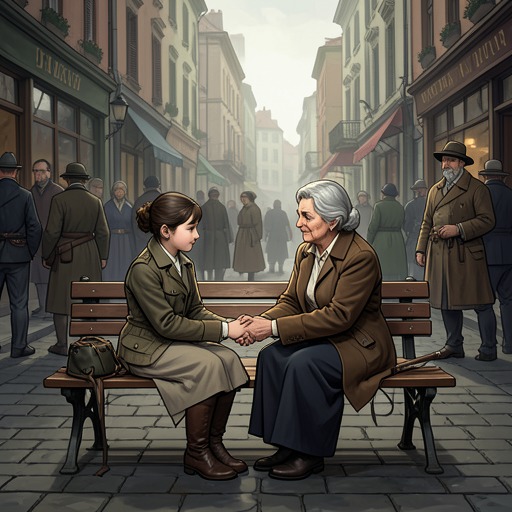
A taxi from Pamplona is already waiting. Rosario has arranged the journey in advance. She takes her bag, bends over the dead child’s cradle, and wraps the tiny body in a fine shawl with practiced skill, placing it in her arms as though it were alive. The gesture gives the departure its disturbing doubleness: she carries a dead infant in the outward form of a mother carrying a living baby. She promises to return the next day, holding the bundle almost tenderly.
Juan’s part in the concealment
For several seconds Juan watches Rosario. Her appearance recalls, for him, the occasions when she took their older daughters to church for baptism. The resemblance makes this departure look almost like another familiar family ritual, even as its purpose is to remove a child from the family’s knowledge. Juan looks down at the surviving baby pressed against him and turns away from his wife for the first time in his life. His silence is part of the plan’s immediate success, but the scene also records its cost: he remains with one daughter and lets Rosario leave with the other.
The records and the later discovery
Years afterward, the concealment is tested against records and family recollections. Amaia Salazar finds that Rosario’s obstetric file records three uncomplicated deliveries: Flora’s birth in 1973, Rosaura’s in 1975, and a twin birth in 1980, with two apparently healthy girls but no names entered. The record establishes that the twins were born, while its omissions leave their identities and subsequent fates unresolved. When Amaia asks whether a baby’s death would have been recorded, she learns that a death in the valley should have had a certificate; the document she obtains names the newborn daughter of Juan Salazar and Rosario Iturzaeta and gives “crib death” as the cause.
The certificate does not settle the matter. Amaia notes contradictions about the stated cause of death, irregularities in the birth certificate, and the discovery of bone remains in unusual circumstances that may belong to her sister. Her relatives say they saw a burial, but the coffin had been closed, and they did not insist on seeing the baby. They had not known of the birth; one relative suggests that Rosario’s relationship with the family changed after the child died. Thus the 1980 journey explains how the death could be both privately handled and broadly concealed, without resolving every question about the child’s death or burial. The scene’s central fact is not simply that Rosario took the body away, but that she made a living twin, a prepared excuse, and a promise to return instruments for keeping the dead child’s existence out of the family’s account.